8 min read
Costa del Sol · August 2026
Moving to Marbella: How to Choose the Area That Fits Your Life
Choosing where to live in Marbella is not only about prices or views. How the life you want, the week around a house and what it gives should shape the search.
The market and Kaluma are not selling the same thing, and it comes down to five things.
The market sells potential — this could be renovated. We look for fit — this isn't yours. It sells the property; we look at the life that will be lived inside it. It sells what impresses on the viewing; we look at what works on day 400. It sells the price it asks; we look at what the house actually gives. And it hands you options where what you need is judgment.
When an agent says the necessary work could be done to meet your requirements, they are resolving their own sale. The sentence is true. It is also how a buyer ends up owning a project they never asked for.
Our sentence is a different one: there are things missing that a renovation doesn't fix. Sometimes saying it means losing the deal.
“That willingness to lose the deal is the authority. It cannot be faked.”
Which is why the work is not really about finding the house. A buyer standing in a home that is wrong for them may already feel it before anyone says so. What they are missing is not the information. It is the permission — someone to name it, explain it, and hold the no up with reasons that stay standing.
That is the function. What follows is how it works when the place in question is Marbella.
Start with the life, not the listings
A property search is a comparison machine. Every listing arrives in the same shape: price, plot, built area, bedrooms, distance to the sea. Laid out side by side, houses look comparable, and the buyer is quietly handed a job nobody agreed to give them — deciding which set of numbers is better.
No life is lived in a search filter.
So we start one step earlier, and the questions are not about the house. Who is going to come to this house, and how often? What do you do on a Tuesday afternoon? What are you moving away from, and what are you moving towards?
Almost nobody arrives with those answers already articulated. That is not a failing. The answer is in them. Nobody has drawn it out.
An example, from central Marbella. A woman wanted to move into the centre. On paper she was looking for good condition and a good location, and there were properties that gave her both. What she was actually looking for was not to feel alone, and for her children to visit and want to stay.
No property specification records that. It was the only thing that decided.
Notice what is doing the work there. Not the area she named. The question underneath it.
It is also why we do not show properties before we understand the life. A viewing arranged too early is not a shortcut. It teaches the buyer to compare the wrong things.
How we choose
Once the life is legible, a property is tested against four things, in order. Any one of them can end it.
LIFE — how you actually want to live. The first test, and the one that orders the others. Not a specification. Who arrives, how often, what an ordinary Tuesday looks like, what you are moving away from and what you are moving towards. Everything after this is read against that answer.
HOUSE — whether it looks after the person living in it. Light, space, room to move and room to stop. But those are symptoms. What sits underneath them is character, and you can renovate a kitchen; you cannot renovate character. A house earns the right to be called a home. That is what we are testing. Is this a house you would show, or a house you would come home to?
PLACE — whether it still works on day 400. The view is enjoyed for the first month. The access is endured for ten years. A house can have long views and sit somewhere that is genuinely hard to reach, and the distance between those two facts is a week of driving, every week, for years. It is the part of a Marbella search that photographs cannot answer.
VALUE — what the house gives, not what it asks. We read a property by what it delivers, not by the number attached to it. Those two do not always agree, and the gap between them is the buyer's money. If nobody had told you the asking price, what would you say this house is worth to you?
And when it doesn't fit, we say so — even when saying so costs us the sale.
The journeys of an ordinary week
There is a sentence that decides more purchases on this coast than any other, and it is almost never said out loud: the view is enjoyed for the first month, the access is endured for ten years.
So we count the journey rather than describing the setting.
The school run — not the distance, the run, twice a day, in traffic, in season. The drive home at night on a road you do not yet know. The Sunday shop. The plumber's visit. The taxi that will not come up the hill.
None of that appears in a listing, and all of it appears in a life.
A house twenty minutes up a hill is one thing in an estate agent's photographs in June. It is another thing in February, at night, in the rain. Both are true. Only one of them is a Tuesday.
“Marbella is sold by area. We read it by lives.”
There is no best area. There is the area that fits how you are going to live, and it is not the same one for two buyers with the same budget.
Which is why the useful question is not where should I buy. It is this: walk us through a week of journeys here. Which of them will you still be making in February, at night, in the rain?
Three areas, and what each one asks of you
What follows is not a ranking, and it is not a shortlist. There is no best area, so a comparison that produces a winner is answering a question nobody should be asking. Three is what it takes to show one argument being settled three different ways: they are here because they differ from each other, not because they are the only addresses worth a life.
These three run in a line inland: the sea, then the valley behind it, then the hills above that. That order is geography. It is not a ladder. Each of them settles the same argument differently — how much of the day goes into getting to things, and what the setting gives you back for it. Each of them gives you something. Each of them asks something back. The right one is the one whose price in daily life you are willing to pay.
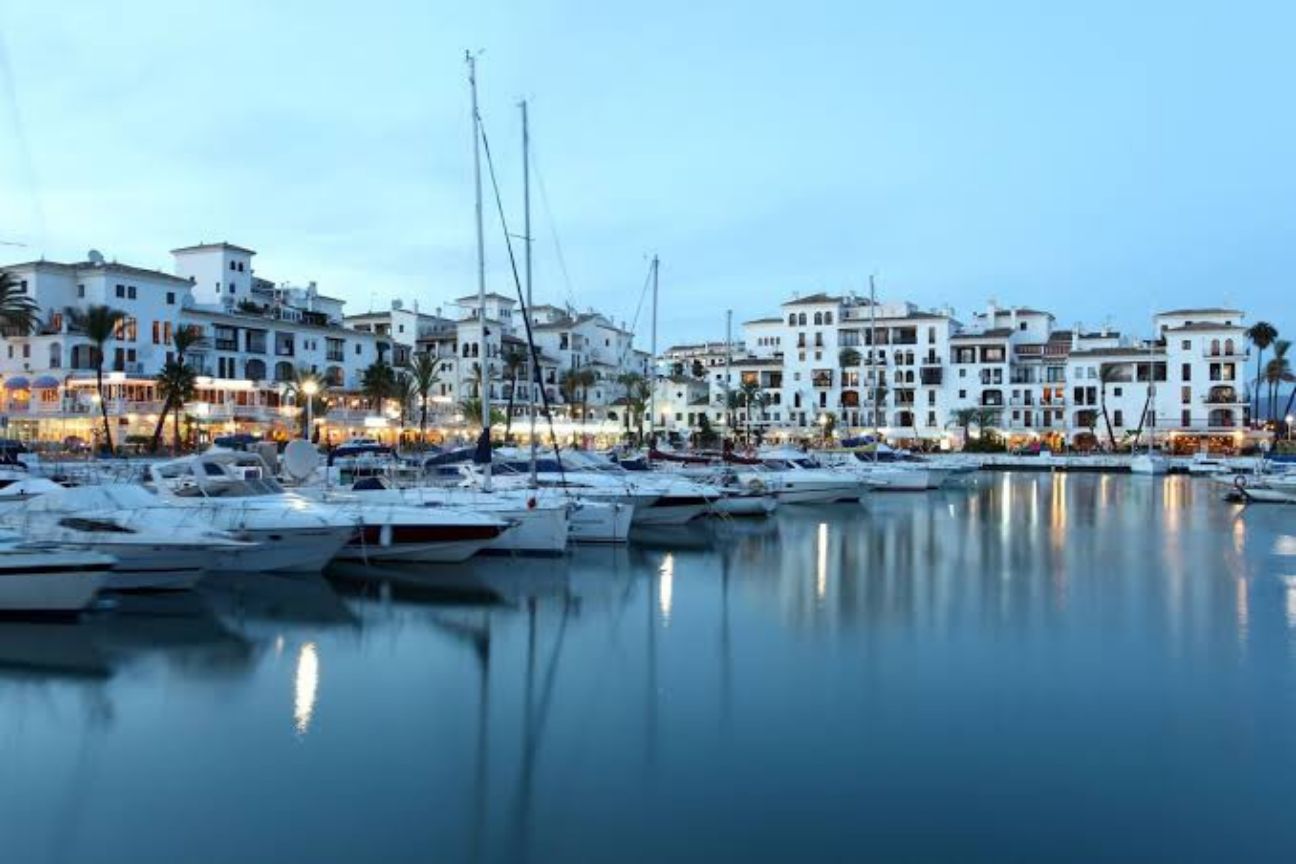
The Golden Mile. The sea as a daily fact rather than a view. Cross the road at the right point and you are on the sand, and the promenade walks you to Puerto Banús. Between Marbella and Banús, most of a week is a short journey rather than a planned one. Up the mountain side, towards Nagüeles, the same address is quiet in a way its reputation does not suggest.
What it asks back is that you know which Golden Mile you have bought. The road divides it into two weeks: on the sea side you cross and you are there; on the mountain side the car is back in the day and the sea becomes a decision. Nearer Marbella or nearer Banús settles the rest. And you pay for position, not square metres — the same money buys more house and more plot inland.
Nueva Andalucía. Privacy without leaving the coast behind: gated streets, houses set back behind trees, Puerto Banús a few minutes down the hill rather than outside the door. Golf on the doorstep, and more of it than you expected — the valley keeps turning up another course, or the Lago de las Tortugas. Much of the week happens inside the urbanisation: the gym, the pool.
What it asks back is the car, and a decision about height. Low down, nearer the road, you can walk to dinner; the casino, La Sala and Naô Pool Club are down there. Higher up the streets climb, the evening is silent and everything is a drive. The buyer it disappoints came for the sea — someone who pictured a walk along the beach and takes the car every single morning to do the one thing they moved for.
Benahavís. Space and privacy, properly: room, ground, distance, views over all of it, golf all around it. It is also better placed than it looks for San Pedro de Alcántara and the top of the golf valley. And there is the village — where everything else up here is driven to, the village is walked. Narrow streets, small squares, restaurants that have been there for years. Most people find it at about six months, usually after they have already bought further up the hill.
What it asks back is proximity, outright. Above the village the car is not a preference — it is every errand, including the supermarket, and there is no part of it that works without one. It is further than the map suggests, and the distance is what people underestimate.
One thing happened three times there, and it is the reason a single visit decides more than it should. Each of these areas is really two: the sea side and the hill side, the low valley and the high valley, the estates and the village. A buyer who falls for the name has already chosen between them, without knowing there was a choice.
Sea, valley, hills. Three different weeks. Moving inland is not moving up — it is trading one set of daily journeys for another and buying something different back. None of them is better. They are answers to different questions, and the question was decided long before the first viewing.
What international buyers underestimate
Driving times in season. A route measured in February is a different route in August. Neither number is wrong. The mistake is only ever having one of them.
The school run as a run, not a distance. Distance is a fact about a map. The run is a fact about two people, five mornings a week, for years.
A second home behaves nothing like a relocation. A house you visit forgives things a house you live in does not. The reverse is also true, and the two rhythms rarely want the same address.
Maintenance, and lock-up-and-leave. A garden and a pool are a pleasure when you are here and a standing arrangement when you are not.
Who actually arrives, and whether the house is built for them staying. Guests you imagined turn into guests who book flights. The difference between a house that can hold them and one that cannot is not the number of bedrooms. It is whether two households can share it without living on top of each other.
The difference between a holiday feeling and a Tuesday. Almost everyone views in a holiday state of mind. Almost nobody lives in one.
A note on how we are paid
The fourth test is the uncomfortable one, so it is worth being plain about the mechanics behind it.
Our fee depends on a sale happening. On this coast an agent's fee is customarily carried inside the sale price rather than added on top of it, so it does not usually reach the buyer as a separate charge — but it still depends on a sale happening. That is a fact about how this industry is built, not a character flaw.
It is also why, when a price objection comes from us, it is worth listening to.
Next step
Not sure which area fits the life you want? Start with a discovery conversation.
We would rather spend an hour on how you want to live than a weekend showing you houses that were never going to be yours.
Before choosing a property, choose the life you want to live.
Interested in the market?
We can help you find the right property.