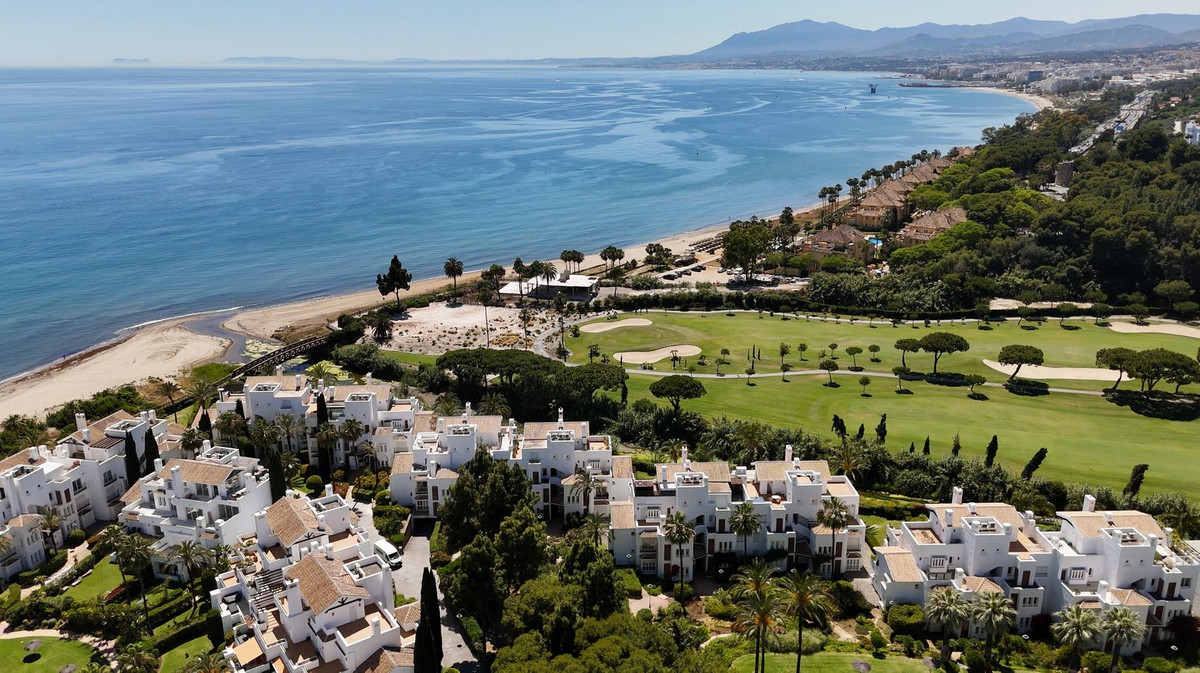
Málaga · Mediterranean
The Costa del Sol
Spain's most established international coast, and the one most often bought for the wrong reason. What it does better than anywhere else in the country is work immediately. What it asks in return is that you accept how built it is.
What it is
The Costa del Sol is the Mediterranean coast of Málaga province. It runs from Nerja in the east to Manilva and Sotogrande in the west. Marbella sits at its centre and defines its reputation, for better and for worse.
It has been building an international infrastructure for sixty years. Marbella, the Golden Mile, La Zagaleta: these are not simply places but ecosystems. International schools, private clinics, year-round golf, a property market that trades at scale.
What living here is actually like
The thing that distinguishes this coast is not weather. It is that the infrastructure already works.
A family arriving in September finds school places, a paediatrician who speaks their language, a notary who has handled hundreds of foreign purchases, and a padel club with space on a Tuesday. Nothing has to be invented. On most of the alternatives compared against it, a good deal has to be invented, and the inventing is done in a language the buyer is still learning.
The cost of that is density
The coastal strip between Málaga and Estepona is continuously built. There is no stretch of it that feels undiscovered, and no amount of elevation changes that.
Traffic on the A-7 in August is genuinely bad. The season has a shape: July and August belong to visitors, and residents plan around it rather than pretend otherwise. A buyer who wants to feel remote will not feel remote here, at any budget, at any altitude.
Liquidity is the argument buyers underprice
This is one of the most liquid prime markets in Spain. If life changes in four years, there is a buyer. On most of the coasts weighed against it, there is not, or there is one at a price nobody wants to hear.
For a purchase this size the exit matters as much as the entry, and it is the factor buyers most consistently leave out of the calculation. It is worth saying out loud at the beginning, because it is very expensive to discover at the end.
01
Who this coast suits
- Buyers relocating full-time who need an infrastructure that functions immediately: international schools, medical facilities, a community already in place, and a market with the liquidity to make an exit straightforward if circumstances change.
- Buyers who will use the property more than eight weeks a year. Below that threshold the density trade is a poor one, and the Atlantic side usually reads better.
- Buyers who want the decision to be reversible. Almost nowhere else in Spain offers that at this end of the market.
02
Who it does not suit
- Buyers who want to be the only foreign family in the village. That is not available here, and no address on this coast delivers it.
- Buyers whose picture of Spain was formed by the interior: the white village, the empty road, the bar with one menu. That Spain exists and it is ninety minutes away, but it is not this.
- Buyers who intend to visit twice a year. They are paying the premium of a liquid market for a property they will not use, and the service charges will run whether they come or not.
- Buyers who want to be told this coast has no downside. It has one, it is called August, and anyone who does not mention it is selling.
If none of that sounds like yours
Then the question is probably not which address on this coast. It is whether this is your coast at all. Ninety minutes west, the Atlantic side of Cádiz province answers a different set of questions and asks harder ones about infrastructure.
The addresses inside the Costa del Sol are set out separately, one line each.
Common questions
What is the difference between the Costa del Sol and the Costa de la Luz for property buyers?
The Costa del Sol faces east into the Mediterranean and has spent sixty years building an international infrastructure: international schools, private clinics, year-round golf, and the most established prime property market in Spain. The Costa de la Luz faces west into the Atlantic, in Cádiz province, and has resisted that development. It is quieter, wilder and thinner on services, with white villages, long empty beaches and UNESCO Biosphere Reserves. The two are about ninety minutes apart on good roads and they suit genuinely different buyers, which is why choosing between them is a bigger decision than choosing between two properties on either one.
Which area of the Costa del Sol is best for buying property?
There is no best area, and the question usually needs replacing before it can be answered. What decides it is the ordinary week: the school run, the drive home at night in February, how far the nearest supermarket is, whether a taxi will come up the hill. La Zagaleta buys privacy at the cost of distance from everything. The Golden Mile buys proximity, and whether that costs you privacy depends on which side of the road you are on. Nueva Andalucía and La Quinta sit between the two and are where more people actually live rather than visit. Each address has a different price per square metre and a different resale market, and those two facts do not always move together.
Is the Costa del Sol too built up?
For some buyers, yes, and it is better to establish that early. The strip between Málaga and Estepona is continuously developed, the A-7 is heavily congested in August, and July and August belong to visitors. What that density buys is an infrastructure that works from day one and a market you can sell into. If that trade does not appeal, the Atlantic coast of Cádiz province is the alternative worth looking at, and it makes the opposite trade.
Is Costa del Sol property easy to resell?
More easily than most of Spain. This is one of the most liquid prime coastal markets in the country, with continuous international demand and a large enough transaction volume that comparable evidence actually exists when it comes to pricing. That does not mean any property resells: overpriced stock sits here as it does anywhere, and a house bought without regard for the week around it is harder to sell than the market average suggests. But the exit route exists, which is not true everywhere it is compared to.
Before you choose a coast
We will tell you if this is the wrong one
A short conversation is usually enough to establish whether this coast fits what you are trying to do, or whether the Atlantic side answers it better. If it is the wrong coast for you, that is a useful outcome and we would rather reach it before the viewings than after them.