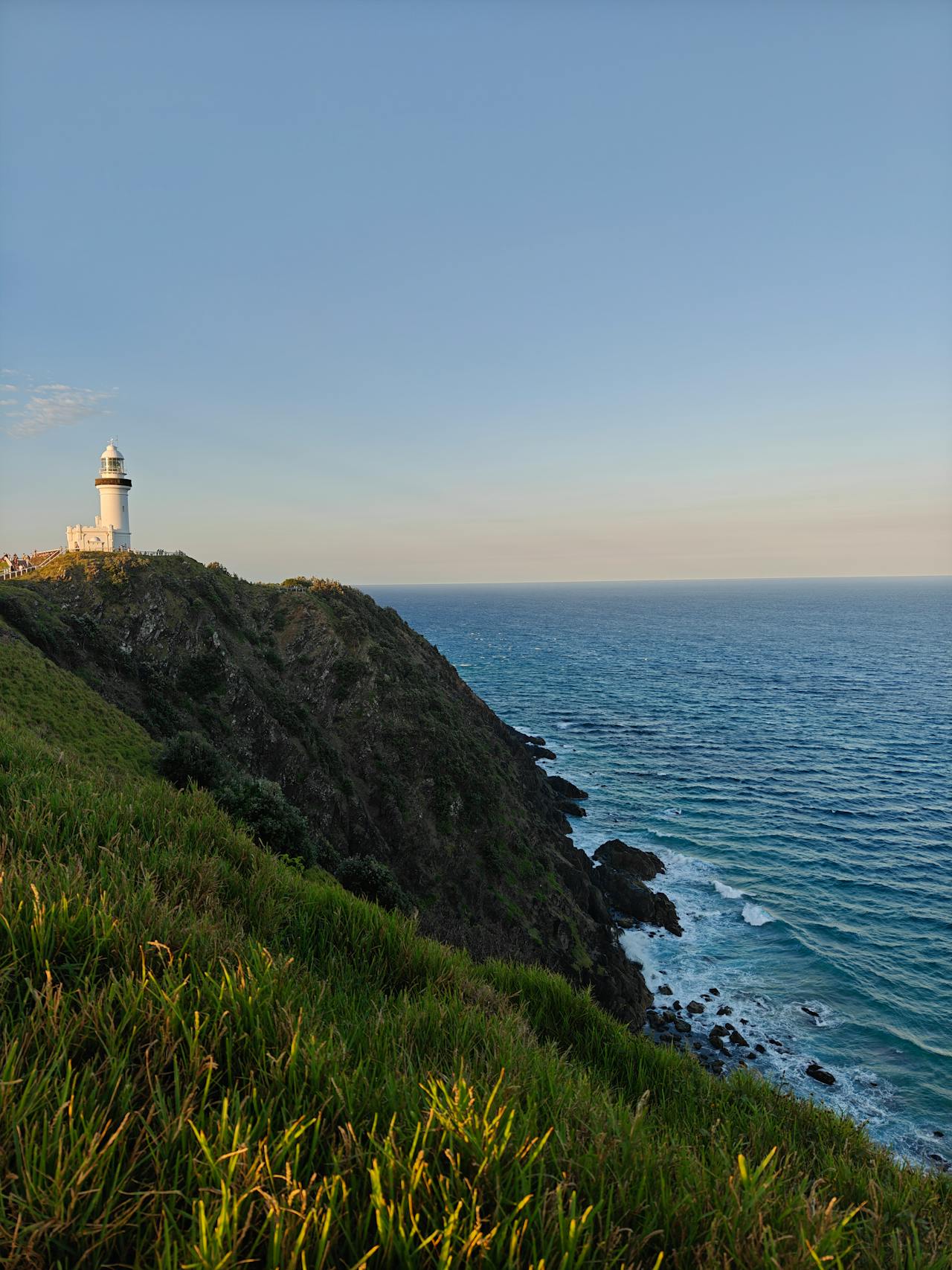
Australia · Byron Bay / Noosa
The Conscious Coast
Where the subtropical climate has produced an architecture of radical honesty. Zinc roofs, sun-bleached timber, and patios that turn the ocean breeze into the primary cooling system.

The climate as the architect
Byron Bay and Noosa sit on Australia's subtropical east coast, where the combination of warmth, humidity, and prevailing Pacific breezes has produced an architectural culture of genuine climate intelligence. The houses that work here are not the ones that fight the heat with mechanical cooling — they are the ones that let the ocean air move through them. Cross-ventilation is not a feature; it is the structural logic of every plan.
The vernacular response to this climate — developed over generations in the Northern Rivers and Sunshine Coast regions — combines corrugated iron roofing (which sheds heat rapidly after sundown), deep verandas that shade the walls through the long summer afternoon, and timber construction that breathes rather than trapping heat. Contemporary firms like Balanced Earth Architects have extended this vernacular logic into hempcrete construction, rammed earth walls, and passive solar design calculated for this specific latitude. The result is houses that stay cool through subtropical summers without air conditioning.
Balanced Earth Architects describes their approach as designing for 'materials biology' — understanding not just the thermal performance of a building material but its chemical and biological interaction with the people who live with it. Hempcrete, for example, is not only an excellent insulator but actively sequesters carbon through its mineral content, and provides a living wall surface that regulates humidity naturally.

“The ocean breeze is the best air conditioning system ever invented. The architecture that understands this never needs to replace it.”
Kaluma Living

The veranda as primary architecture
The veranda is the defining spatial invention of Australian coastal architecture — and its logic is purely functional. A deep veranda shades the wall behind it for most of the day, keeping the interior cool. It creates an intermediate climate zone between inside and outside — sheltered from rain, shaded from direct sun, but fully open to breeze. It extends the liveable area of the house without adding to its thermal load. In a good climate, it is the most important room in the house.
Noosa's architectural culture has developed this principle to its fullest expression. Houses here face north-east to capture the prevailing sea breeze, with verandas sized to the latitude — deep enough to shade the wall at the summer solstice, angled to allow the lower winter sun in for passive heating. Rob Mills Architecture, working across Byron Bay and Noosa, consistently produces houses where the outdoor living space is the architectural priority, with the interior organised around the connection to it.
What the zinc roof teaches
The corrugated zinc roof has become the signifier of Australian coastal architecture — and it is worth understanding why. Zinc sheds solar heat more rapidly than tile or concrete after sundown. It provides a robust, low-maintenance surface that performs through decades of UV exposure, salt air, and cyclonic rain. It is light, which reduces structural loads. And it ages to a particular grey-silver patina that belongs to the coastal landscape in a way that imported materials never achieve.
On the Costa del Sol, the equivalent logic leads to different materials — local limestone, traditional ceramic tile, hand-finished stucco — but the same principle applies: the material that performs best in this climate over the longest period is the one that has already been tested here for centuries. Byron Bay's zinc roof is Andalusia's sandstone. The intelligence is identical: use what the place offers, and trust that it was developed for a reason.
Looking for a home that belongs to its landscape?
We curate properties on the Costa del Sol and Costa de la Luz where the relationship with nature is built in — not an afterthought, not a marketing claim, but the foundation of how the home was conceived.